


Common Thread Machining Methods in CNC Precision Manufacturing
Common Thread Machining Methods in CNC Precision Manufacturing
Thread machining is one of the most critical processes in mechanical manufacturing. In CNC precision parts processing, common thread machining methods include thread cutting, thread turning, thread milling, thread grinding, and thread rolling.
Among these, CNC lathe threading has become increasingly popular due to its simplicity, efficiency, and suitability for small-batch custom and standard thread production.
Main Methods of Thread Machining
Thread machining can generally be divided into two categories: Thread cutting processing and Thread rolling (forming) processing.
1. Thread Cutting
Thread cutting refers to machining threads using cutting tools or abrasives. Common methods include:
- Turning
- Milling
- Tapping
- Die threading
- Grinding
- Lapping
- Whirling
During turning, milling, or grinding, the machine ensures precise axial movement of the tool relative to the workpiece for each rotation, achieving accurate thread pitch.
1.1 Threading Turning
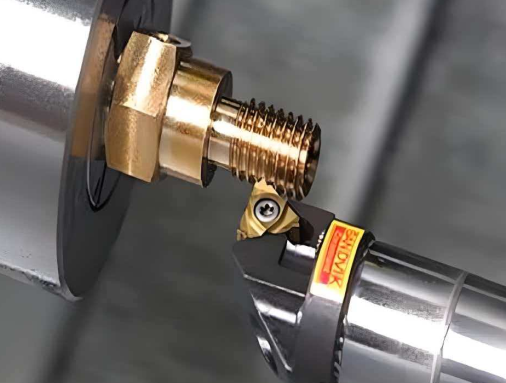
Thread turning on CNC lathes is widely used for its flexibility and efficiency.
- Form tools are simple and ideal for small-batch production;
- Thread comb tools offer higher efficiency but are suitable for medium to large production runs.
CNC lathes can quickly produce both standard and non-standard threads, making them a preferred choice in modern machining workshops.
1.2 Thread Milling
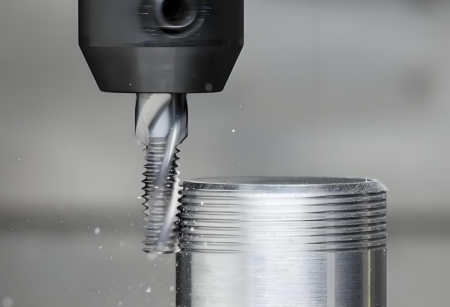
Thread milling is performed using disc cutters or comb-type milling cutters.
- Suitable for internal and external threads
- High efficiency (often completed in 1–1.5 rotations)
- Achieves moderate precision and good surface finish
This method is ideal for batch production or pre-processing before grinding.
1.3 Thread Grinding
Thread grinding is mainly used for hardened materials and high-precision threads.
- Achieves high accuracy (up to grade 5–6);
- Excellent surface finish;
- Suitable for lead screws, thread gauges, and precision worms.
Different grinding methods include single-line and multi-line grinding.
1.4 Thread Lapping
Thread lapping improves pitch accuracy and surface quality by using softer tools (such as cast iron) to polish pre-machined threads.
It is commonly used for:
- Precision internal threads
- Correction of pitch errors
- Post-heat-treatment finishing
1.5 Tapping and Die Threading
- Tapping: used to machine internal threads
- Die threading: used to machine external threads
These methods can be performed manually or using machines such as drilling machines, tapping machines, or lathes. For small-diameter internal threads, tapping remains the primary method.
2. Thread Rolling
Thread rolling is a forming process that produces threads through plastic deformation.
Advantages:
- Superior surface finish
- Increased strength and hardness due to cold working
- High material utilization
- Excellent production efficiency
- Long tool life
Limitations:
- Material hardness must typically be below HRC 40
- High requirements for blank accuracy and tooling
- Not suitable for asymmetric thread profiles
Thread rolling is widely used for mass production of fasteners and threaded components.
Types of Thread Rolling
Thread rolling can be divided into:
- Flat die thread rolling
- Radial thread rolling
- Tangential (planetary) thread rolling
- Thread rolling head (used in automatic lathes)
Each method offers different advantages in terms of efficiency, precision, and application scenarios.
Conclusion
Selecting the appropriate thread machining method depends on multiple factors, including material, thread type, precision requirements, and production volume.
As a professional CNC precision parts manufacturer, we provide customized thread machining solutions using advanced CNC equipment to ensure high quality, efficiency, and cost-effectiveness.
Contact us today to learn more about our CNC threading capabilities and precision machining services.


