


Why Heat Treatment is Essential for Metal Parts in CNC Machining
H1: Why Heat Treatment is Essential for Metal Parts in CNC Machining
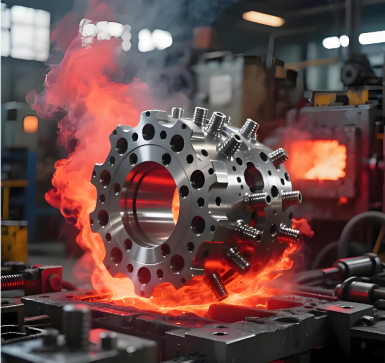
Key benefits of heat treatment include:
- Improved hardness, strength, and wear resistance
- Reduced residual stress from machining and forming
- Enhanced machinability for efficient CNC processing
- Better dimensional stability for high-precision parts
H2: Types of Heat Treatment Processes in CNC Machining
Heat treatment processes are generally divided into two categories:
Each plays a different role in the manufacturing workflow.
H2: Preliminary Heat Treatment: Improving Machinability and Stability
Preliminary heat treatment prepares the material for machining and improves internal structure.
- Annealing is commonly used for high-carbon steels to reduce hardness and improve cutting performance
- Normalizing is suitable for low-carbon steels to prevent excessive softness and ensure stable machining
H3: Stress Relief (Aging Treatment)
Residual stress can lead to deformation during machining or long-term use.
Stress relief treatment is widely used for:
For tight-tolerance components, multiple stress relief cycles may be required.
This process improves overall mechanical performance and produces a stable microstructure.
In some applications, it can also serve as the final heat treatment.
H2: Final Heat Treatment: Enhancing Performance and Durability
Final heat treatment determines the ultimate performance of the part.
H3: Quenching (Surface Hardening vs Through Hardening)
Surface hardening is widely used in CNC machining due to:
Carburizing increases carbon content on the surface of low-carbon steel parts.
Nitriding is a low-temperature process ideal for high-precision CNC parts.
This makes nitriding especially suitable for finished or near-finished parts.
H2: How to Choose the Right Heat Treatment Process?
Selecting the right heat treatment depends on:
- Material type (carbon steel, alloy steel, etc.)
- Mechanical property requirements
- Tolerance and precision requirements
- End-use application (automotive, aerospace, industrial)
H2: Conclusion: Heat Treatment is Critical for High-Quality CNC Parts
- Preliminary heat treatment improves machinability and stability
- Final heat treatment enhances hardness, durability, and lifespan


