


Causes of Machining Errors: A Complete Guide to Improving CNC Machining Accuracy
Causes of Machining Errors in CNC Machining
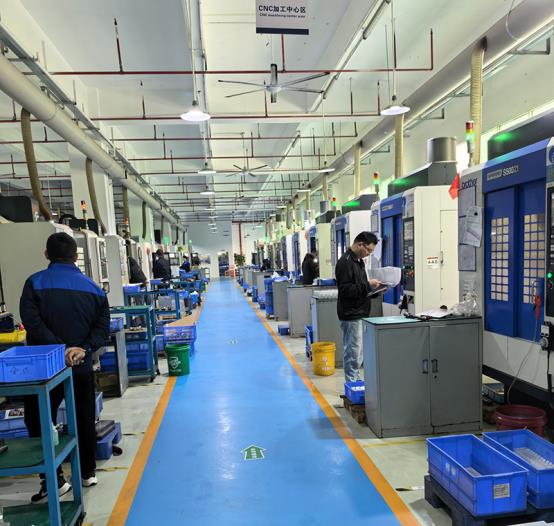
With the rapid development of automation and intelligent CNC machines, machining accuracy and stability have significantly improved. However, machining errors can still occur in production, leading to quality issues and economic losses.
Understanding the causes of machining errors is essential for improving precision, reducing scrap rates, and ensuring consistent product quality.
1. Machine Tool Errors
Machine tool errors are one of the primary sources of machining inaccuracies and include:
Spindle Rotation Error
This refers to the deviation between the actual spindle axis and its ideal rotation axis.
Causes include:
- Poor spindle coaxiality
- Bearing errors
- Misalignment between bearings
- Spindle deformation
These errors directly affect the dimensional accuracy of the workpiece.
Guideway Error
Guideways determine the relative position and movement of machine components.
Main causes:
- Manufacturing inaccuracies
- Uneven wear
- Poor installation quality
Transmission Chain Error
This refers to motion errors between transmission components.
Causes:
- Manufacturing and assembly errors
- Wear during operation
2. Tool Errors
Cutting tools inevitably wear during machining, which affects part geometry and dimensions.
- Tool wear changes size and shape
- Tool geometry errors affect machining accuracy depending on tool type
- For fixed-size tools, manufacturing tolerance directly impacts precision
Proper tool maintenance and selection are critical.
3. Fixture Errors
Fixtures are used to correctly position the workpiece relative to the tool and machine.
- Fixture geometric errors can cause positioning deviations
- These errors mainly affect dimensional and positional accuracy
4. Positioning Errors
Positioning errors include:
Datum Misalignment
Occurs when the machining datum does not match the design datum.
Locating Pair Errors
Caused by:
- Manufacturing inaccuracies
- Clearance between locating elements
These errors lead to incorrect positioning of the workpiece.
5. Errors Caused by Deformation of the Process System
Workpiece Rigidity
If the workpiece has low rigidity:
- It may deform under cutting forces
- Resulting in dimensional errors
Tool Rigidity
- Tools with low stiffness (e.g., boring bars) may bend
- This significantly affects machining accuracy
Machine Rigidity
Machine components consist of multiple parts, and their rigidity is influenced by:
- Contact surface deformation
- Friction
- Clearance between components
6. Thermal Deformation Errors
Heat generated during machining causes expansion in the machine, tool, and workpiece.
- Thermal deformation can account for up to 50% of total machining error
- Especially significant in:
* Precision machining
* Large part machining
7. Adjustment Errors
During machining setup, adjustments are required to align the system.
Errors occur due to:
- Inaccurate setup
- Misalignment of tool, fixture, or workpiece
When initial accuracy is sufficient, adjustment errors can become the dominant factor.
8. Measurement Errors
Measurement errors occur during or after machining.
They are influenced by:
- Measurement methods
- Tool accuracy
- Workpiece condition
- Human factors
9. Errors Caused by Internal Stress
Internal stress exists within materials even without external forces.
When released:
- The material deforms
- Machining accuracy is reduced
This is especially common after heat treatment or material removal.
Why Understanding Machining Errors Matters
Identifying and controlling machining errors helps:
- Improve product quality
- Enhance machining accuracy
- Reduce production costs
- Increase manufacturing efficiency
In precision CNC machining, minimizing errors is key to maintaining competitiveness.
FAQ – Machining Errors in CNC Machining
1. What is the most common cause of machining error?
Machine tool errors and tool wear are among the most common causes.
2. How can machining accuracy be improved?
- Use high-quality tools
- Maintain machine alignment
- Optimize cutting parameters
- Control temperature and vibration
3. Why is thermal deformation important?
Because it can contribute up to 50% of total machining errors, especially in precision parts.
Conclusion
Machining errors are caused by a combination of factors, including machine tool inaccuracies, tool wear, fixture issues, thermal deformation, and internal stress.
By understanding these causes and applying appropriate solutions, manufacturers can significantly improve machining precision and product quality.
Looking for high-precision CNC machining with strict quality control?
Contact us today for reliable manufacturing solutions and competitive pricing.


